
Manuale viatoris
1 .690,00 Kč
An authentic-looking medieval liturgical book that can actually be used for singing, reading, and conducting ceremonies during a game.
Manuale Viatoris is a practical liturgical codex designed for historical LARPs, reenactment events, in-game services, and anyone interested in medieval singing and culture.
It is intended primarily for characters portraying priests, cantors, pilgrims, and others who lead services, sing, read aloud, or perform ceremonies at historical events.
The codex is particularly suitable for:
✅ historical LARP players
✅ participants in reenactment events
✅ singers and musicians interested in early music
✅ students of music and music history
✅ those interested in chant
✅ enthusiasts of the Middle Ages and medieval music
Pre-order
The codex is currently in preparation and is expected to be published in October 2026. By pre-ordering, you will support the production of the first edition and secure your own copy.
Description
An authentic-looking medieval liturgical book that can actually be used for singing, reading, and conducting ceremonies during a game.
Manuale Viatoris is a liturgical codex inspired by medieval breviaries and missals. It is designed primarily for historical LARP players, reenactors, and anyone who wishes to use a convincing medieval-style liturgical book at historical events.
It is not a reproduction of any single surviving medieval manuscript. Instead, it is a newly compiled codex that respects the appearance, language, and practical use of medieval liturgical books.
The codex contains texts for services and offices, written with black mensural notation so that the book can also serve as a songbook. It also includes a selection of ceremonies from the Rituale, short biblical lessons suitable for use during services, chants for various occasions, and other texts that have proven useful in actual historical games and reenactment events.
The contents are based on many years of experience organising historical services at LARPs and reenactment events. The selected texts are those that have proved most practical and versatile in real use. Their choice and length reflect what actually works during historical games and reconstructions.
A player portraying a priest, a cantor, or a singing member of the congregation will find everything they need in one book.
The entire codex is written in Latin so that it resembles an authentic medieval manuscript and can be used in an international environment. Each copy is accompanied by a separate guide containing translations, explanations of the Latin rubrics, instructions for using the codex, and practical notes.
This allows the codex itself to remain linguistically universal, while the accompanying guide is supplied in a range of language versions.
Manuale Viatoris is a prop and practical handbook intended for historical games and reenactment. It is not an official liturgical book of any church and is not intended to replace modern liturgical books.
The included texts are broadly relevant to the period from the 13th to the 15th century. The codex is not a reconstruction of a book from one specific year. Both visually and in terms of content, it draws primarily on European liturgical manuscripts of the High and Late Middle Ages. It is designed to look convincing across a wide range of historical games and reenactment settings.
What will I find in the package?
- The Manuale Viatoris codex itself, leather-bound in the style of a medieval travelling breviary.
- A booklet of translated and localised texts, including instructions for using the codex and explanations of its Latin content. When ordering, you will select the language of the guide and lectionary. Czech, English, Polish, German, and French versions are currently planned.
- Several sheets in the language of your choice, entitled Lectiones vernaculae, designed to be inserted into the codex as gatefold pages.
The localised lessons are supplied as separate fold-out sheets. You may use them separately, attach them to the codex according to the enclosed instructions, or choose to have them inserted before your order is dispatched.
What does Manuale Viatoris contain?
Six coloured ribbon markers allow you to find the correct section quickly.
⚪ Officium
A sequence of psalms, readings, and prayers, including the Lord’s Prayer.
🔴 Missa
This section contains the complete Ordinary of the Mass — Kyrie, Gloria, Credo, Sanctus, and Agnus Dei — supplemented by Alleluia chants and other pieces in several different versions.
Together with the Lectiones section, it allows you to assemble and conduct a complete sung non-Eucharistic service during a game.
The chants have been selected so that even people without previous musical or liturgical experience can learn them quickly and easily.
🟢 Cantiones
A collection of songs and chants, including:
Laudemus, Salva nos, Ut queant laxis, Stella splendens, Gaudete, Cuncti simus concanentes, Ave maris stella, Adoramus, Salve Regina, Da pacem, Domine, Jezu Kriste, Buoh všemohúcí, Svatý Václave, Benedicamus, the Song of Songs, and several others.
🟡 Lectiones
This section contains a selection of readings.
It helps a player portraying a priest choose an appropriate reading and also offers ideas for developing the text into a sermon. The section is designed with the expectation that the role may be played by a layperson with no previous religious or liturgical experience.
The selection covers situations commonly encountered in historical games and provides suitable inspiration for the in-game priest.
A complete service, including the readings, can therefore be prepared using Manuale Viatoris alone, without the need to carry a separate Bible.
This section of the codex is language-specific. You will be able to insert the version in your chosen language directly into the codex.
⚫ Rituale
This section contains ceremonies, blessings, and solemn rites commonly used at LARPs and reenactment events, including marriage, the dubbing of a knight, and admission into an order.
🔵 Mappae — Medieval Maps
The practical part of the codex is supplemented by maps of regions in which our historical games take place. The codex can therefore replace several separate game handbooks.
The maps include Languedoc, the Kingdom of Bohemia, the Near East, and Europe.
Blank pages at the end of the book allow you to add further texts and notes according to your own needs.
Players of the LARPs Albigenští — Good People of Languedoc, Interregnum 1313, Vigilie, and Akkon 1291 will find all the information they would otherwise have to carry separately during the game.
The codex is not limited to these particular games, however. It is a universal handbook for anyone who has wandered into the Middle Ages.
Technical specifications
- format: A5
- length: 96 pages
- approximate weight: 400 g
- sewn binding with hard covers
- fixed leather covering
- six integrated coloured ribbon markers
- paper and printing designed to evoke the appearance of a historical codex
- every copy is finished by hand
How does the singing course voucher work?
- The course takes place in person.
- Current dates are always listed on choral.cz and cestycasem.cz.
- The courses are held at the Cathedral Church of Saint Lawrence on Petřín Hill in Prague.
- The customer may choose from the currently available dates.
- The voucher is transferable.
- The voucher may be redeemed at any time and never expires.
Manuale Viatoris FAQ
Is it a copy of a real medieval manuscript?
No. It is a newly compiled codex inspired by medieval liturgical books.
Is the entire codex written in Latin?
Yes. A separate guide containing translations and explanations in Czech, English, and other languages is included.
Can I use it at a LARP or reenactment event?
Yes. That is precisely what it was created for.
Is it suitable for singing?
Yes. It contains black mensural notation and can serve as a songbook covering the situations commonly encountered at a LARP or reenactment event.
Does it contain musical notation?
Yes. The chants are written in black mensural notation — medieval-style musical notation — and are accompanied by their complete texts.
Do I need to know how to read mensural notation?
No. The guide explains the basic principles of reading the notation. Audio examples will also be available for selected chants, allowing you to learn them by ear.
Will I find everything I need as an in-game priest or cantor?
Yes. That is exactly how the codex has been designed.
Players of Cesty časem games will find everything they already know from our in-game services, together with many additional chants and texts.
Do I need to know Latin?
No. The codex itself is deliberately kept in Latin so that it resembles an authentic medieval manuscript, but every copy includes a guide with translations, explanations, and instructions for use.
During an event, you will usually not need to consult the explanations. You can use the codex as a songbook and, should you wish, add your own notes in the same way medieval cantors often did.
Is this an academic book, or can it be used without a background in musicology?
It is not an academic publication.
It is designed for complete beginners, both musically and religiously — most commonly LARP players and reenactors who will use it as a songbook, source of inspiration, and collection of useful texts.
Those looking for an academic book on historical music theory should choose Musica humana instead.
Who is the book not intended for?
The codex is not a critical edition of a single historical source, nor is it a textbook of Latin, liturgy, or mensural notation.
It is primarily a practical, authentic-looking book designed for use during historical games and events.
How large and heavy is the codex?
The codex is A5 format, contains 96 pages, and weighs approximately 400 g.
It is designed as a travelling book that can be comfortably carried throughout a game or historical event.
How demanding are the medieval singing courses?
The courses are beginner-friendly and accessible.
You do not need a musical education, you do not have to be an active musician or a trained singer, and you do not need to be able to sight-read music.
All you need is a willingness to learn something new and the ability to reproduce a melody at the correct pitch.
Additional information
| Jazyková mutace průvodce | česky, deutsch, english, Français, Polski |
|---|
Related products
-
Sale!
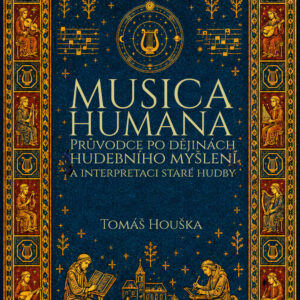
Musica Humana A cultural history preorder
Original price was: 1 .090,00 Kč.850,00 KčCurrent price is: 850,00 Kč. Add to basketMusica Humana A cultural history preorder
A cultural history of musical thought and a practical guide to interpreting medieval music
English First Edition — Pre-order Expected publication: Q4 2027
The English edition of Musica Humana is currently being translated, edited and prepared for publication.
By placing a pre-order, you secure a copy of the first English edition at the introductory pre-order price and directly support its translation and production.
This is a paid pre-order. Your copy will be dispatched after publication in 2027. We will send occasional email updates as the translation, editing, printing and dispatch progress.
The estimated publication date may change if the translation or production process requires additional time. Should the edition be cancelled, all pre-order payments will be refunded in full.
Pre-order customers may cancel their order and request a full refund at any time before the book enters physical production.
Who is the book for?
✅ For musicians, historians and all those who want to understand medieval musical thought.
✅ Especially for performers of early music. Musicians, singers, conductors, conservatory students, musicologists and all those who want to understand music before the ars nova as closely as possible to the preserved sources.
✅ It can be an inspiration for cultural anthropologists, religious scholars, historians and those interested in the history of European culture. It is written in such a way that a student, an experienced performer and someone who is just starting out with early music can take something from it.
✅ Students of music history
PRE-ORDER — English edition planned for Q4 2027
Pay now to secure a copy of the first English edition at the introductory price. This product is not currently in stock and will be dispatched after publication.
Original price was: 1 .090,00 Kč.850,00 KčCurrent price is: 850,00 Kč.
Reviews
There are no reviews yet.